

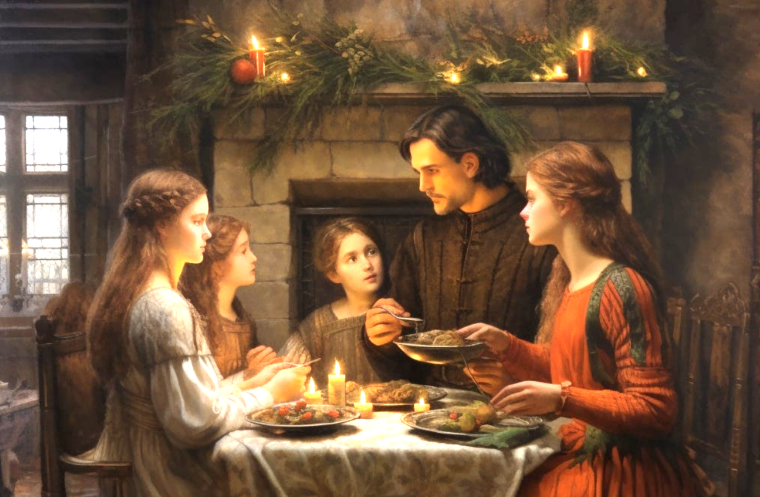
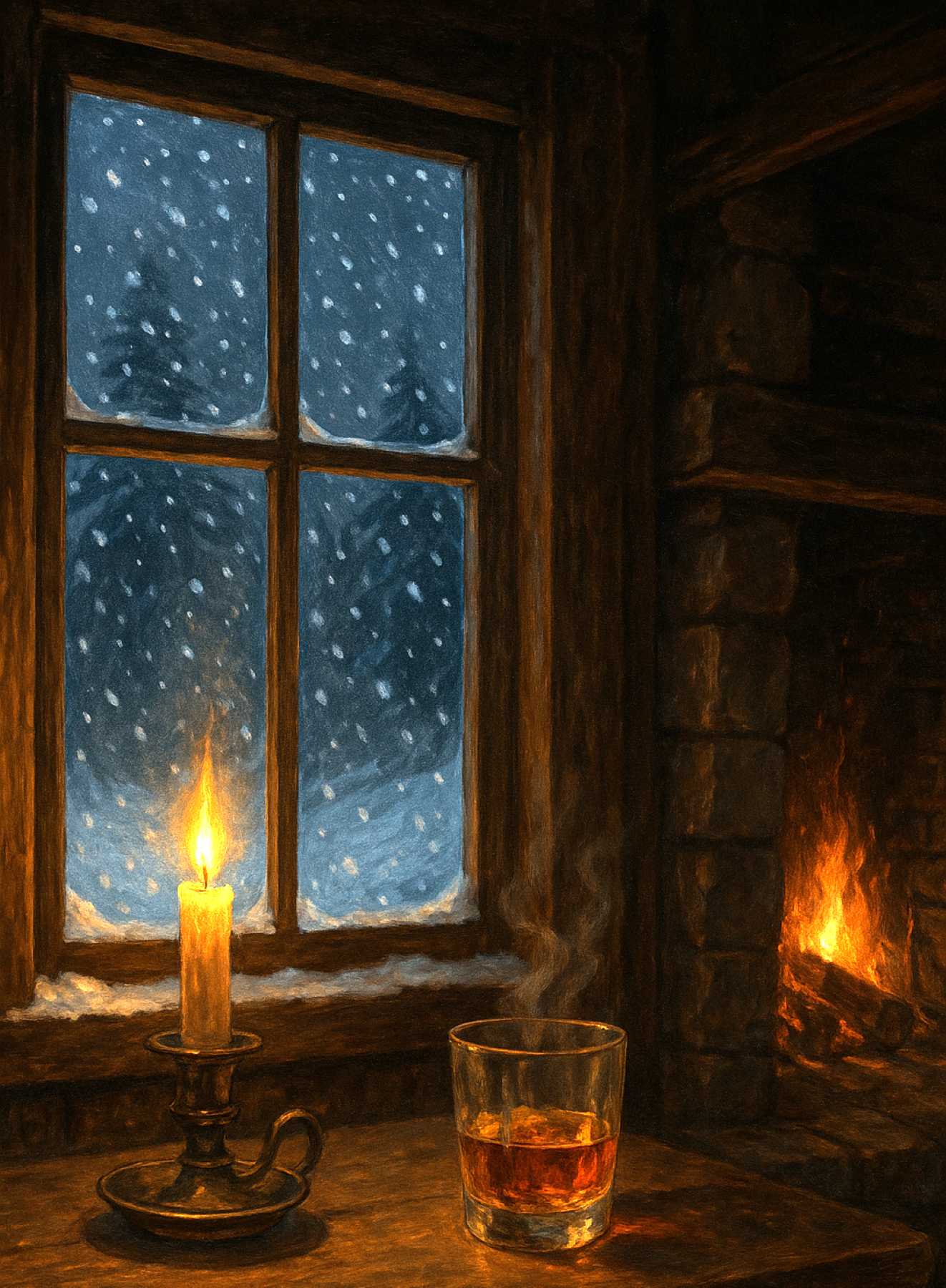
Snow falls like mist outside a window. Upon its sill, a candle flickers – an old Irish custom that in ancient times served as a guiding light for lonely travelers, and later, symbolically, as a lodestar for the Holy Family. Inside, by the fire, a glass of whisky glows amber, its vapour rising upwards like an invisible ghost. In that space of light and warmth, a question lingers: What is the Christmas spirit? When did it begin, and is it still with us today?
In the literal sense, “spirits” can be defined as fiery beverages created from grain or fruit. These spirits were often shared with others during winter’s darkest season, and very well might bring forth something beneath the surface when the howling wind was the only constant.
Lisa Roth reminds us in her essay Whiskey and the Irish Language, that even the word whiskey has roots in the sacred. “‘Uisce beatha,’” she explains, “first appeared in Irish texts in the 15th century and was gradually anglicized into ‘usquebaugh,’ ‘usky,’ and eventually ‘whiskey.’” Its original meaning, ‘water of life,’ tells us that spirit, in all its forms, was always meant to warm both body and soul.
Aside from the spirits in Christmas cocktails, the holiday spirit is something a little harder to distill. It might be compared to the glow of whisky by the fire, or the candle in the window, but is there more to it?
Tracing that Christmas spirit through time leads us back through centuries of change, from pagan bonfires that called for the return of the sun, to the candlelit vigils of early Christians, to the harsher glare of modern celebrations. Each generation has tried, in its own way, to keep the light and spirit of the season alive.
Historically, the idea of a seasonal spirit evolved from centuries of solstice festivals as communal acts to combat winter’s bleakness through light, song, stories, and shared food and drink. Dickens went even further with A Christmas Carol, which illustrated the transformation of a hardened soul who finally saw the light through visits from spirits in ghostly form.
So, is the Christmas Spirit derived from meaning and memory? History provides some clues.
 Before Bethlehem
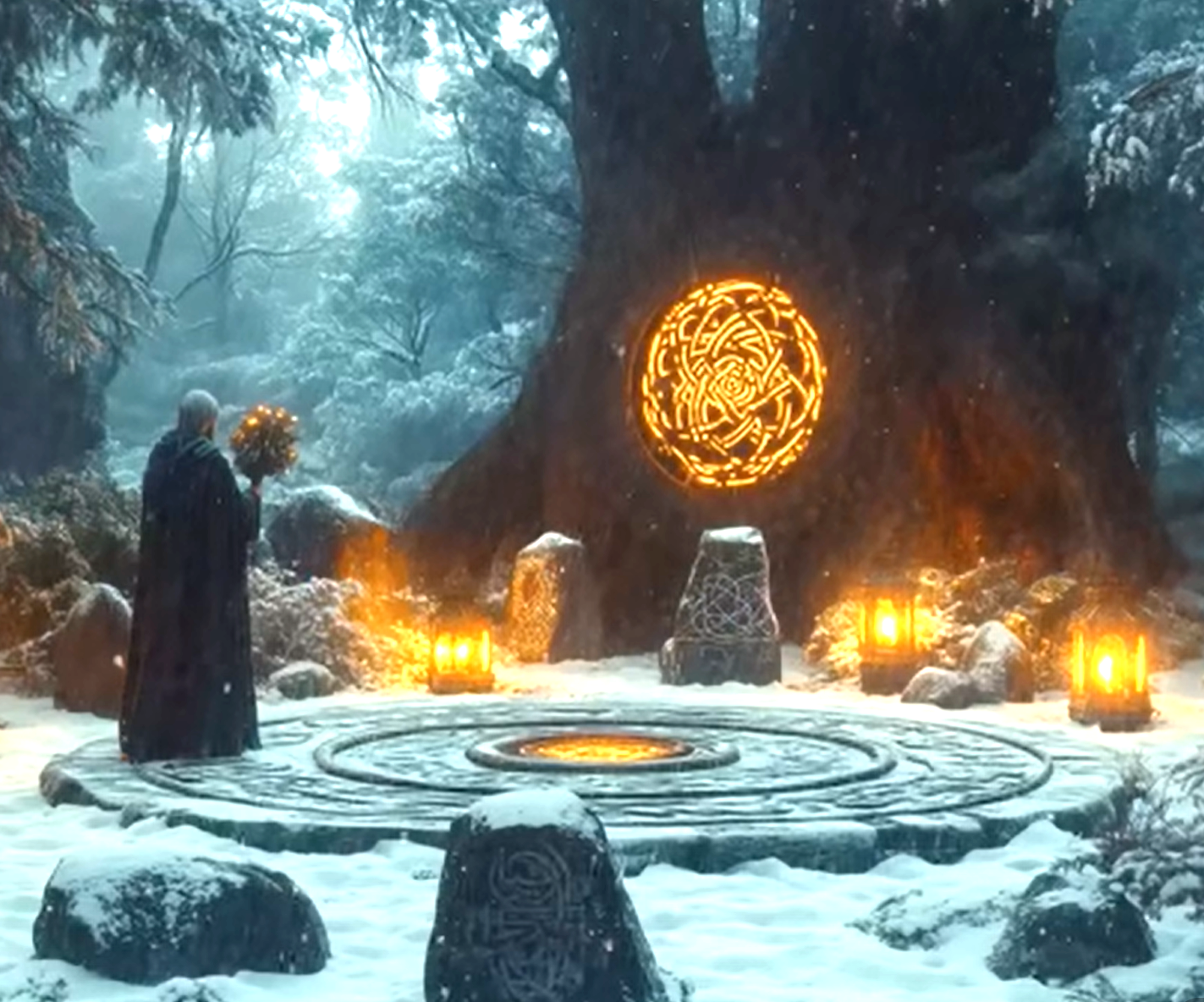
Long before Bethlehem, midwinter was a sacred time of both darkness and hope. Across the Celtic world, people gathered around big bonfires to honor Yule and the turning of the year’s wheel when the sun sank low before beginning its return.
As one Celtic Life International historian writes, “In December, at the very darkest time of the year, we head towards the Winter Solstice, when the new light is born out of the womb of winter.” The word solstice signifies a standstill for the three days when the sun seems to pause before it is reborn. During those long, cold nights, the land appears barren yet slowly awakens as light ascends again. For the pagans, such nights were about gratitude and survival. With food scarce and temperatures harsh, the ancient Celts shared warmth, ale, and song.
The great Yule fires blazed not only to banish the dark, but to affirm the coming of light. This was the first whisper of what we might call “Christmas spirit.” Across time and culture, that sentiment found many expressions.
While the Celts celebrated Alban Arthuan – the Druidic solstice festival that honored the sun’s rebirth – the Church later adopted the same season for the Nativity of Christ, although there is some debate as to the actual date of Jesus’ birth.
By whatever name, the season has never really changed in its purpose: to bring hope out of despair, light from darkness.
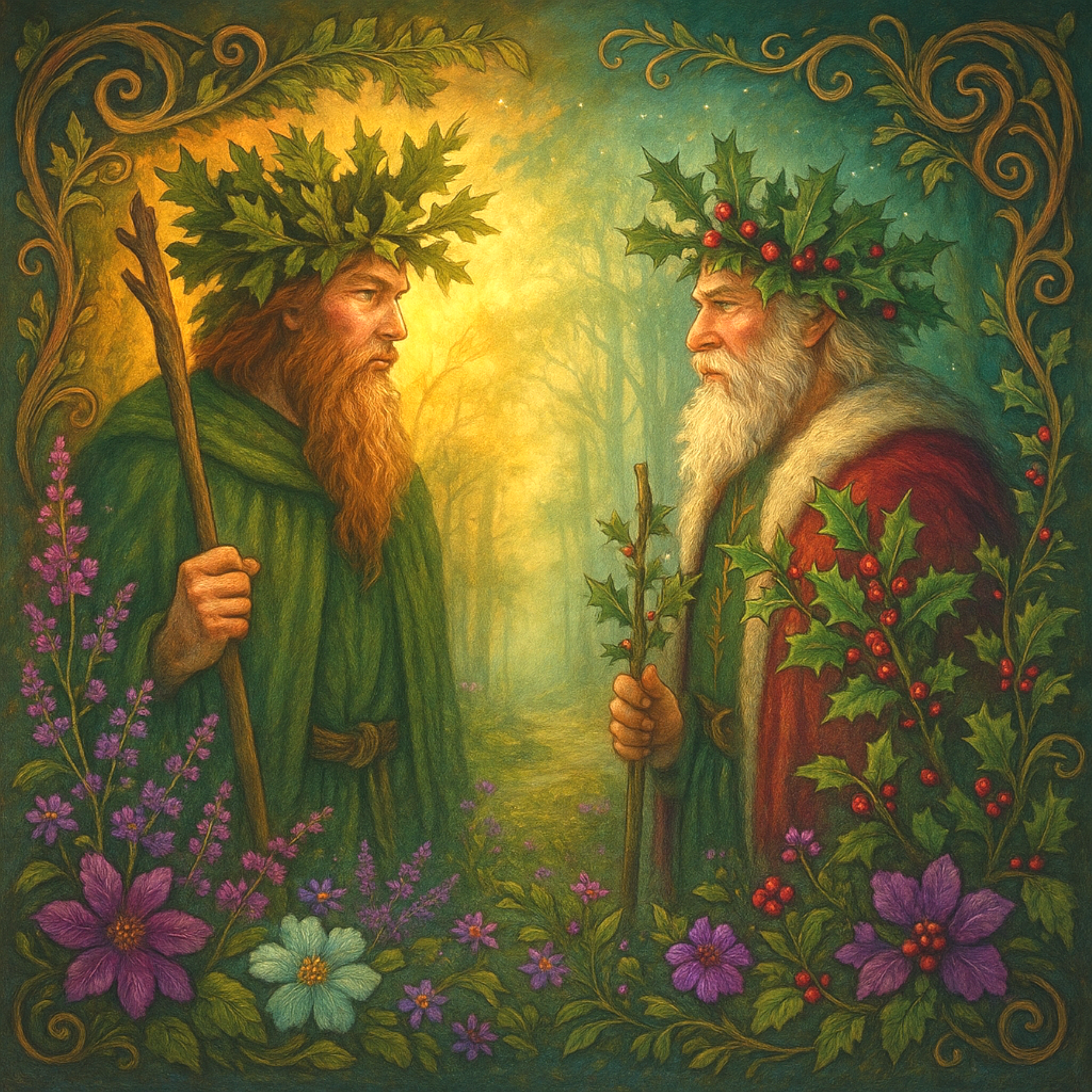
Among the old tales, the Oak King and Holly King battled over the seasons. The Oak King, representing light, was reborn at Yule, while the Holly King, guardian of shadow, began his retreat. Their eternal exchange revealed an ancient rhythm of death and renewal that a large part of humanity would later retell in the story of Christ’s birth, his death, and resurrection.
The making of the spirits themselves – ale, mead, or whisky – was a rite in itself. Turning grain into liquid fire was a sacred way of transforming the earth’s gifts into a spirit, too.
Irish storyteller Tomaseen Foley remembers that spirit from the winters of his childhood. “It was as if, at Christmastime, an errant angel left the door to Heaven slightly ajar,” he writes, “and the heavenly light shone down on us mere mortals. The neighbors, drawn together by that light, would gather around the fire and almost raise the rafters with the wild joy of their jigs.”
Before Christmas had its Christian name, there was already faith in the sun’s return, in the merriment of kinship, and in the belief that light triumphs over dark. Every candle that flickers today, every shared cup, still honors an ancestral hope.
And so, the spirit of Christmas, born from ancient fires and midwinter faith, continued to evolve, shifting its form, yet carrying the same light forward into the next part of its story.
From Yule to Noel
Early Celtic Christianity emerged in the British Isles around the 4th century, melding the region’s ancient pagan traditions with the growing Christian influence of Rome. The result was a distinct faith attuned to nature, marked by ritual and creativity, and carried by missionaries who preferred persuasion to conquest. “See in each herb and small animal, every bird and beast, and in each man and woman, the eternal Word of God,” wrote St. Ninian, one of the earliest Celtic saints. A Briton trained in Rome, he returned north to bring Christianity to the Picts, bridging old and new worlds with strategy, yet subtlety.
Missionaries like Ninian reinterpreted familiar symbols to express Christian meaning. Evergreens, long recognized as signs of endurance in winter, came to represent the Christian concept of eternal life. Gift-giving, once an offering to spirits and an exchange of goodwill between clans, was linked to the Magi’s offerings at the Nativity. Even sacred fire rituals endured, such as the eternal flame once tended for the goddess Brigid, continued under Christian nuns in honour of the saint of the same name. And let’s not exclude the modern cities and towns lit up like – well, Christmas trees, each December.
According to the 2024 article Celtic Christmas Customs, “Although a celebration of the Son’s birth replaced that of the Sun’s, a number of Christmas-tide traditions – including those the ancient Celts practiced – remain today.” Holly, once a pagan emblem of rebirth, became a symbol of hospitality; mistletoe, believed to hold powers strong enough to “ward off evil spirits and cure illnesses,” survived as a blessing of peace. Candles placed in windows to light the way for strangers symbolically welcomed Mary and Joseph, linking ancient fire festivals with Christian faith.
The heart of this new faith beat in places like Iona, where St. Columba and his followers brought the gospel to Scotland, and to the Book of Kells, where monks illuminated the story of Christ with mystical illustrations from pre-Christian art.
It was a meeting of heaven and hearth – a Celtic Christianity born of community and continuity.
Centuries later, that same spirit endured in song. From the Welsh services sung before dawn, to Irish “Calling the Waites” and the Manx Carval traditions, the voices rose in carols with devotion and merriment. Cornish singers, as one 19th-century account noted, “walked miles to chapels to practice their Christmas songs,” keeping the season alive through music and fellowship.
The blending of old and new created a Christmas that was both mystical and human, a festival of light and generosity born on Celtic soil. As centuries passed, the story unfolded, and the spirit of Christmas evolved through people who still carried its light.
A Celtic Home at Christmas
For the Celts, the season has always been about home, hearth, music, and song, bridging one generation to the next.
In Ireland, the candle still sits in the window, and holly still hangs in the doorway. Before midnight mass, houses are scrubbed, the scent of soap and peat mingling with meals cooking in the kitchen. Afterwards, neighbours gather in low-lit pubs where fiddles play, and glasses lift in a quiet toast of Beannachtaí na Nollag.
In Scotland, when the kirk banned Christmas, the Scots kept the day alive through kindness and hospitality. The “first-footer” was welcome, bearing gifts of coal, shortbread, salt, and whisky, to ensure good fortune for the year ahead. Peat smoke rose from stone chimneys; card games and reels carried the night until Hogmanay morning. As one nineteenth-century account in the Celtic Christmas Customs article recalled, “the Scots did keep Christmas-day, and in the same kindly Christian spirit that we all do.”
Farther west in Wales, men rose before dawn for Plygain services sung in ominous three-part tones. Later came Eisteddfod carols, wassail bowls spiked with ale, and the eerie parade of Mari Lwyd. Behind all of it lies the same intention of every Celtic feast: to call in luck, laughter, and light, and dispel darkness.
Through all of these traditions runs the belief that no one should face the darkness alone. All offerings were to both the living and the dead, serving as reminders that the veil is thin and kinship is eternal. It was in the quiet following the festivities that the Christmas spirit grew stronger.
Yet, there is another spirit associated with Christmas. Ghosts. Do such darker spirits have their place in Yule? History would indicate that indeed they do.
The Ghosts of Christmas Past
“I will honour Christmas in my heart and try to keep it all the year. I will live in the Past, the Present, and the Future. The Spirits of all Three shall strive within me.’’ – Ebenezer Scrooge, from A Christmas Carol, by Charles Dickens.
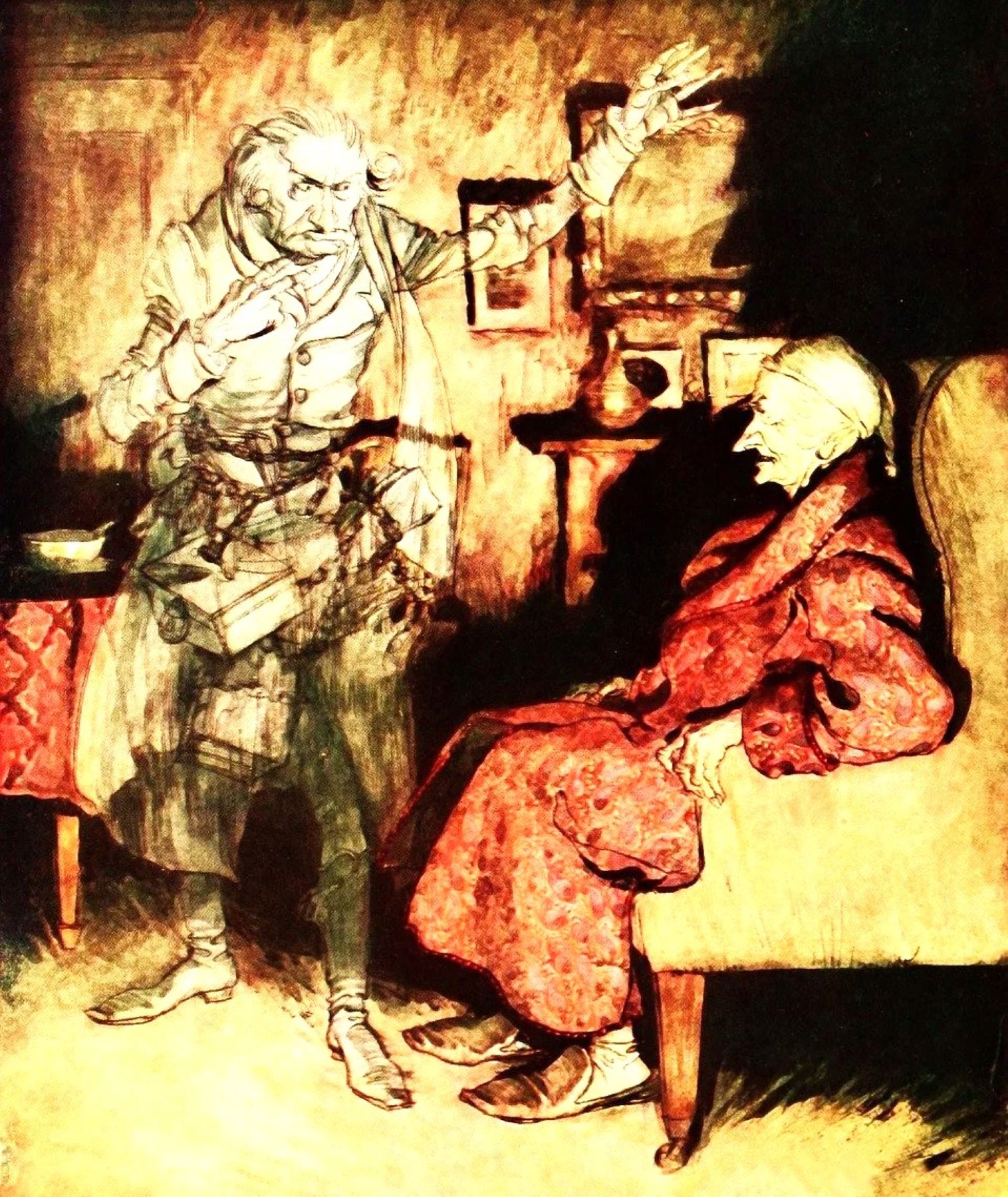
Christmas has always been linked with ghosts. Dickens merely reflected what the Celts, and later the Victorians, already knew: that midwinter is when the veil grows thin, and the living and the dead can meet again. In A Christmas Carol, Scrooge’s haunting becomes an awakening through memory. Each of the spirits that visit him – the Ghosts of Past, Present, and Yet to Come – and reveal what a haunting truly means: to remember.
In the British Isles, ghost stories were once a Yuletide staple shared long before Halloween claimed the custom. With the landscape buried beneath frost, stories were told by the fireside against the cold and darkness. As essayist Eric Know writes in The Supernatural Creatures of Christmas Folklore, “Winter has always felt a bit spooky…the air feels charged and crackles as if spirits dance around us.” The Victorians simply brought back what pagans always understood: that paradoxically, we find illumination within the shadows.
One of the most prominent examples is the Mari Lwyd – a draped horse’s skull knocking at doors in Wales at Christmas. Part mummer’s game, part dialogue with death, the custom brought both laughter and unease. In the Highlands, tales of the Cailleach, the Winter Hag who governs storms, reminded everyone that nature was supreme and often harsh. And in Norse and Gaelic lore, the Wild Hunt thundered across the sky with a folkloric procession of macabre spirits and creatures as part of a winter blizzard believed to be an omen of doom.
Such tales were not only meant to be frightening but served as an otherworldly lesson that kept people mindful of their place in the turning of the Great Wheel.
Every bit of Christmas cheer, from fires lit to sharing a cup, was both a devotion and a defiance against despair.
Perhaps the ghosts of Christmas remain as a reminder that joy is forged from gathering together against the harsher aspects of life, both literal and figurative, and offering gifts not as a sacrifice, but as an affirmation of our gratitude. From ancient pagan practices to Dickens’ Victorian tale, to modern families huddled at home together, sheltered from winter storms and shopping fatigue, those darker spirits are instrumental in creating bright and lasting warmth as we attempt to conjure a Christmas spirit each year.
The Modern Disconnection
Today’s Christmas ghosts are not folkloric but human, like shadows that haunt our own hectic hearts. In the clattering crowds of busy shopping malls, the ever-present glow of phone screens, and the quiet exhaustion of the season’s frenetic pace, we struggle to create meaning in an age that may not value Christmas spirit at all. The wind may still howl outside the door, but we don’t notice amid our many distractions, our restlessness, and our disconnection from nature, purpose, and one another.
Christmas has become, for many, a paradox: still wondrous yet weary, abundant, yet somehow as empty as our bank accounts in January. The old stories of community, song, and sacred fire have been replaced by blaring refurbished carols in concrete settings and glaring lights across cities and towns. Beneath the frenzy, though, is that longing still there? To gather, to give, and be warmed by a unifying presence?
One Scottish distiller believes as such. “When people raise a dram together, they remember who they are. That’s the real spirit – not what’s in the glass, but what it brings out of us.” In Wales, a choir director held a similar truth: “Every voice that joins the carol carries something older than the song – a sense of belonging to be shared.”
Even now, despite the din of consumerism, candles still flicker in windows, a stranger still pays for another’s coffee, someone visits an elderly neighbour, and a parent whispers an old carol to a child. The rituals may have changed form, but the impulse has not. The spirit isn’t gone, only dispersed – muffled under fatigue and some cynicism, no doubt, but waiting to be remembered. Maybe if we pause and offer a moment of our time, forgiveness, or warmth, it will burn brightly again.
 An Inner Light that Endures
In the end, the Christmas spirit isn’t one single thing. It’s a shared field of energy we co-create when goodwill outweighs self-interest – even for just a short while. It’s in the moments when people soften, when memory, myth, and ritual briefly override the numbness of ordinary life. Psychologically, it is a collective return to meaning and memory; hopefully, belonging; perhaps even innocence, and ultimately, grace. It is the longing to reconnect with something greater than ourselves.
The Celts of old knew this truth. They believed that divinity resides in all things. They understood the true meaning of anam cara – soul friendship – and how each act of kindness strengthens the bond between beings. The flame that once burned for Brigid at Kildare still burns in us each time we come in from the cold and help someone else do the same.
Perhaps then, Christmas is not a season but a memory we collectively acknowledge each year to somehow affirm the light in the darkness, within and without. And it endures and waits for us there in the lamplight, the snow, and the close and holy dark.
“Looking through my bedroom window, out into the moonlight and the unending smoke-colored snow, I could see the lights in the windows of all the other houses on our hill and hear the music rising from them up the long, steadily falling night. I turned the gas down; I got into bed. I said some words to the close and holy darkness, and then I slept.” – Dylan Thomas, A Child’s Christmas in Wales.









Leave a Comment