

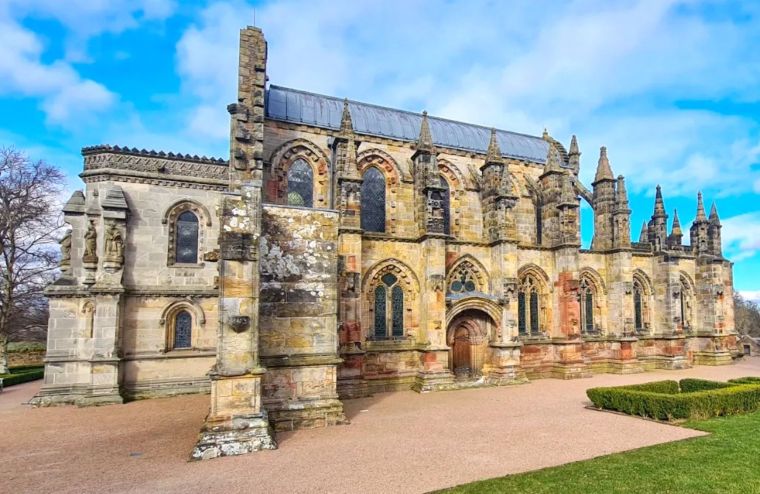
While in Scotland recently, my wife and I visited the Rosslyn Chapel, just south of Edinburgh. As we listened to the presentation on the chapel’s history, iconography, and mythology, I noticed a piece of the story that was not included – one I had gone specifically to learn more about. I had read that motifs of sound might have been carved into the stonework, and I was curious to see whether this could be true.
For those unfamiliar with Rosslyn Chapel, it gained international attention after its dramatic portrayal in Dan Brown’s The Da Vinci Code. But long before it became a popular cultural landmark, Rosslyn was renowned for its extraordinary stone carvings – an intricate fusion of medieval symbolism and craftsmanship.
Constructed between 1446 and 1484 by Sir. William St. Clair, the 1st Earl of Caithness and the 3rd and last St. Clair Prince of Orkney, the chapel stands as a testament to the skill of medieval stonemasons. Its interior is adorned with elaborately carved pillars, arches, and ceiling bosses, each telling a story through layers of symbols and historical interpretation.
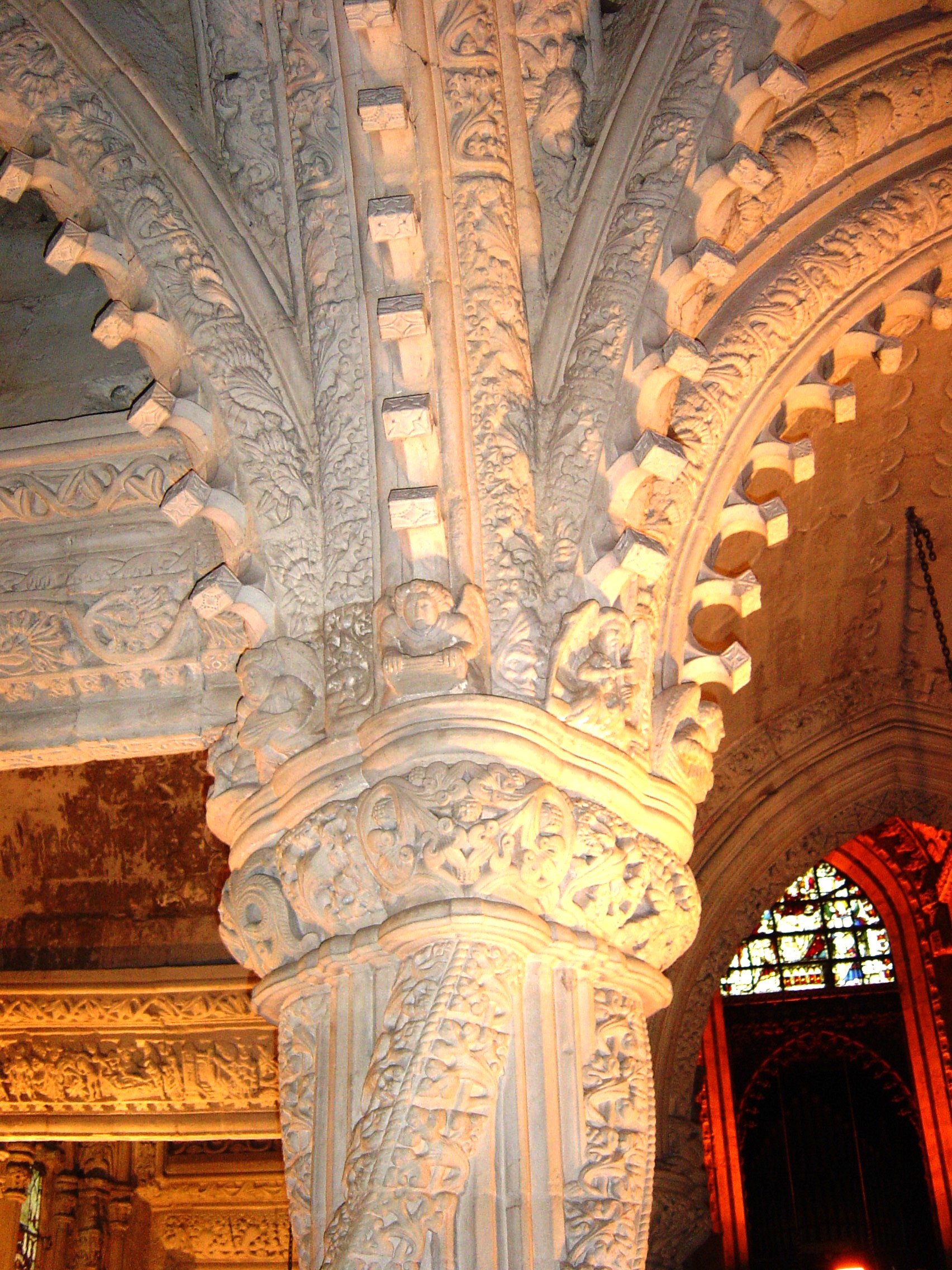
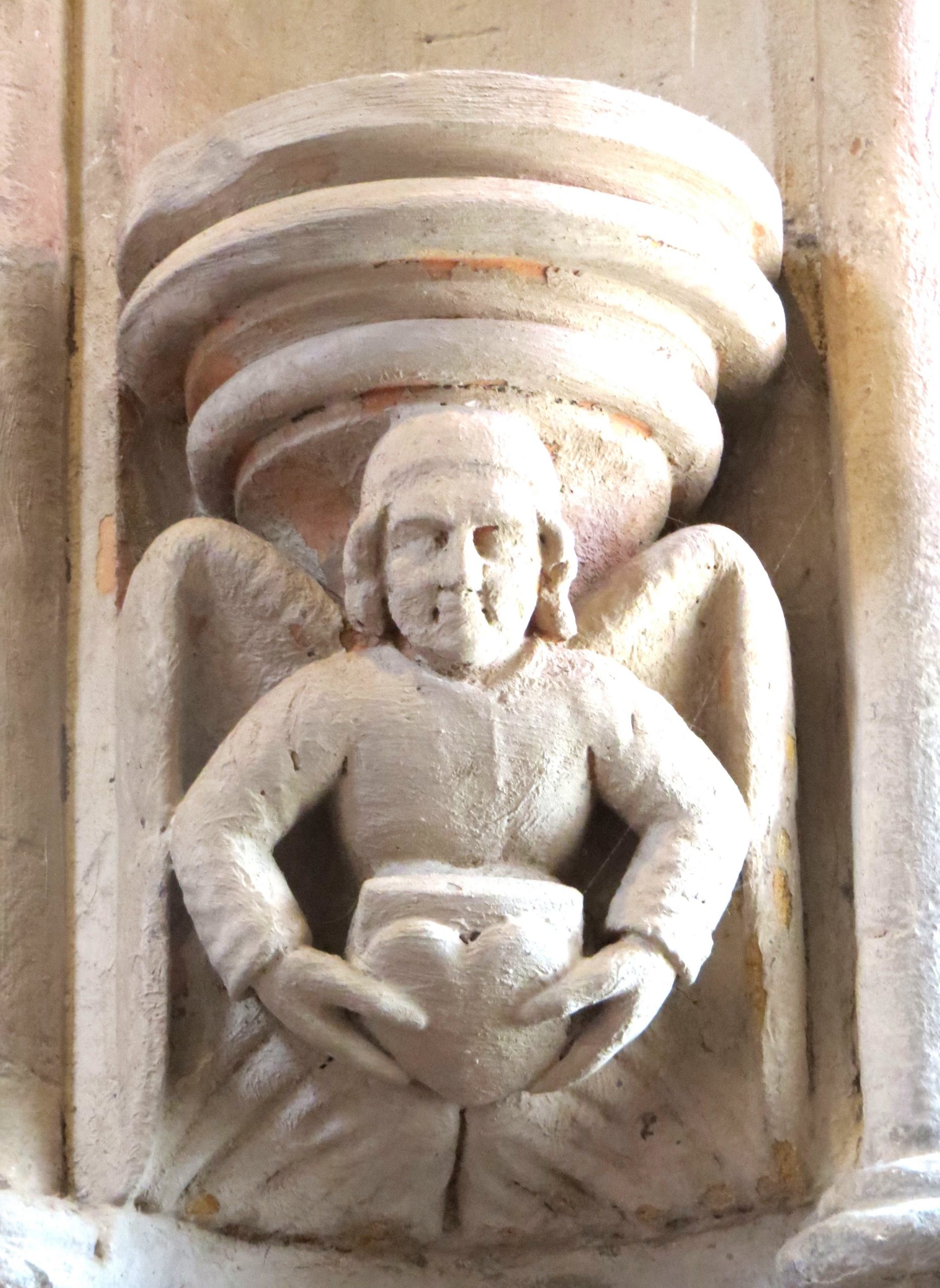
One of the most striking features appears at the top of the three pillars in the Lady Chapel, where a series of angels are carved in exquisite detail. Each angel holds a musical instrument, poised as if waiting for the music to begin.
The angelic ensemble is astonishingly diverse. It includes a psaltery (a harp mounted on a sound box), a tabor (a small snare drum), a gittern (the medieval ancestor of the guitar), along with a tabor, a bowed string instrument, wrist bells, bagpipes, and what appears to be a small portable organ. Together, they appear like a sculpted orchestra, frozen in stone, as if hinting there was more to unravel than meets the eye.
Suspended from the archway above them is another remarkable feature: a series of carved, patterned cubes – two-hundred and thirteen in total. Each cube contains a unique geometric design. For centuries their meaning remained unknown, resisting interpretation and showing no clear correspondence to any recognized medieval iconography.
When the presentation concluded, I asked the interpretive staff if there was any legitimacy to Thomas and Stuart Mitchells’ research, which I had read about prior to our visit. Their faces lit up. They spoke enthusiastically about the Mitchells’ work and how it intersects with other interpretations of the chapel’s symbolic carvings – from highly unusual botanical motifs (only found in North America) to alchemical emblems, astronomical references, and geometric forms that scholars continue to debate. Their enthusiasm suggested that, while unconventional, the Mitchells’ interpretation has become part of the rich tapestry of possibilities through which Rosslyn is increasingly understood.
Thomas Mitchell, an Edinburgh musician and former cryptographer, began studying the cubes in the 1980s. He noticed something unusual: many of the geometric designs noted on the cubes forming the archway resembled the patterns formed by vibrating surfaces- shapes he had seen in the work of German physicist Ernst Chladni. In the 18th century, Chladni developed a method of visualizing sound by sprinkling sand on metal plates and drawing a violin bow along their edges. As the plates hummed, the particles shifted into stars, circles, lattices, and spirals – each frequency producing a distinct and repeatable design, almost like the fingerprint of a tone.
Mitchell wondered whether the carvings depicted on the cubes could also be visual representations of Chladni-like patterns. He made rubbings of the cubes and compared them with known Chladni figures. The parallels were striking, creating similar rosettes, lattices, crossed diagonals, and starbursts. From these, he identified thirteen recurring patterns whose symmetries aligned not only with one another but across all two hundred and thirteen carved cubes.
His son, Stuart Mitchell, a composer, soon joined the study. Together they explored whether the cubes might encode a musical composition, or whether they simply represented an eclectic collection of symbolic forms. Attempting to translate the geometric sequence into musical notes – using Chladni resonance patterns as a guide – they identified harmonic relationships of pitch, sequence, and progression embedded within the designs. Stuart eventually developed these findings into a musical work based on their interpretation, which they titled The Rosslyn Motet.
Seen through the lens the Mitchells opened, the Lady Chapel becomes, in theory, an interpretive space where sound is made visible through carved design. Even if the Chladni connection is a retrospective insight rather than an intentional medieval cipher, the resonance is undeniable. The cubes resemble frequency patterns as their symmetry aligns with harmonic shapes. The question, then, is whether the masons themselves were steeped in similar ideas. Were they influenced by Pythagorean and Platonic concepts of number, proportion, and sound – the ancient notion of the “music of the spheres” – or were there other cultural and sacred influences that modern iconographers have yet to uncover.
The masons may not have spoken of “frequencies” or “resonance modes,” yet their carvings suggest an instinctive understanding that the world is ordered, patterned, and geometrically rhythmic.
Seen this way, Rosslyn Chapel becomes far more than an architectural curiosity. It becomes a place where medieval theology, musical symbolism, and proto-scientific intuition quietly converge.
I recognize that protoscience is, by definition, speculative and still searching for empirical grounding. Yet the emerging field now known as cymatics – a term coined in the 1970s by Swiss physician Hans Jenny to describe the study of sound and vibration made visible – has helped give shape to these intuitions. While the Mitchells’ interpretation may not provide definitive answers, it opens a compelling doorway into understanding Rosslyn as a place where the medieval imagination brushed up against ideas that modern science is only now beginning to articulate.
Taken together, these threads suggest that Rosslyn Chapel may stand at an unexpected crossroads – a place where medieval craftsmanship, sacred symbolism, and the early stirrings of a scientific understanding of vibration all coalesce. Whether or not the masons consciously encoded the patterns of sound into stone, the chapel invites us to consider how deeply interconnected form, frequency, and meaning truly are. The Mitchells’ work does not claim to solve the mystery of Rosslyn, but it broadens the conversation, offering a provocative lens through which to view the chapel’s elaborate carvings.
It reminds us that long before modern physics, many cultures sensed that creation itself might be vibrational in nature – whether in the Vedic tradition of Nada Brahma “the world is sound”, in ancient China where sound was seen as key to harmony between the human and the cosmic, or in Egyptian temples and Gothic cathedrals built with remarkable acoustic precision.
In a modern context, physicists such as Nobel Laureate Frank Wilczek have helped reshape our understanding of matter by describing particles as musical “notes” of the universe, each defined by a unique vibrational motion with its own frequency and behavior.
In this sense, Rosslyn becomes not merely a monument of stone, but a resonant space where the invisible architecture of sound finds tangible expression, inviting us to listen with more than our ears. ~ Story by Gregory Cran
www.rosslynchapel.com
@rosslynchapel








Leave a Comment