

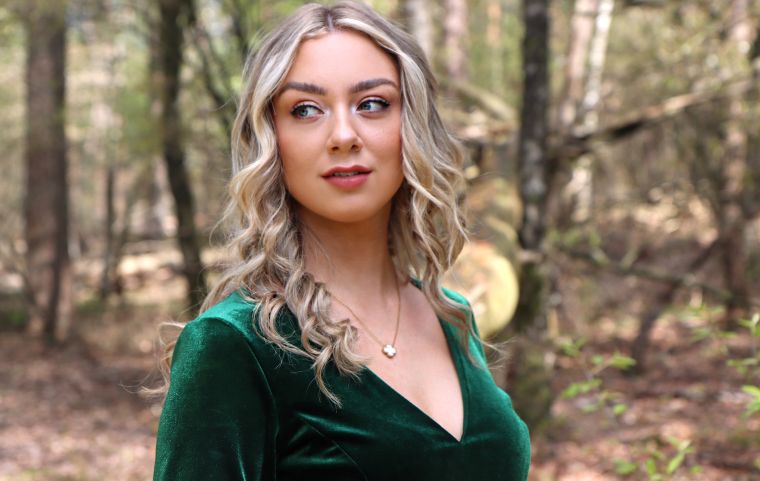
Irish vocalist Caitriona Sherlock is the newest member of Celtic Woman. Recently we spoke with here about connection, culture, and community.
What are your own roots?
I grew up on my family’s dairy farm in County Monaghan, surrounded by the beauty of the Irish countryside. Music and culture oozed out of every corner of the house – the tape recorders and CD players constantly serenaded us with The Chieftains, Bagatelle, Horslips, and songs by the iconic Mary Black, Sinéad O’Connor, and Cara Dillon. So, I was exposed to music from a very young age. I have fond memories of my Grandad Nicholas taking the fiddle down off the wall to play when we’d visit. My father wrote poetry and recitations, and my mother was known to sing Danny Boy at sing-song gatherings. I also have an older brother, Oisín, and much of my childhood was spent playing in the forest, helping on the farm, and singing ‘til the cows came home. We were brought up knowing a lot about our history and culture and took pride in respecting our identity, music, and language – especially being from a border town. My parents taught me to believe in myself, lead with integrity, and always follow my dreams. That mindset really laid the foundation for my career in music.
Where do you currently reside?
I still reside in my beautiful homeland. Honestly, I couldn’t think of a place I’d rather be right now. Family is incredibly important to me and being able to call in to see my relations and my godson and cousins and spend time with them is a luxury not everyone has so I have to cherish and make time for that when I can. It also keeps me connected to Ireland’s vibrant music scene while touring and collaborating internationally. My home county of Monaghan is also the birthplace of the poet Patrick Kavanagh, singer Big Tom, and actresses Caitríona Balfe, Charlene McKenna and Aoibhinn McGinnity, there’s something in the air here that keeps the creative spirit alive.
When and why did you first become interested in music?
I started singing from a very young age – it was my aunties who suggested to my mother that I take singing lessons because I “wouldn’t stop singing around the house.” From there, I began traditional singing lessons with a wonderful woman named Monica Beagon. Learning these songs opened a gateway for me to connect with the history, heritage, and stories of my ancestors that I was enthralled by. I always had a love for reading – especially Irish literature – so that’s one reason I was drawn to traditional song. It felt like the pulse of my ancestors moving through me. We were taught that we’re not meant to be the focus; we’re just vessels through which the stories and songs flow. That idea really stuck with me – it is sacred, in a way. Even though these songs are hundreds of years old I felt that I could always find a piece of myself and my story within it and getting to express myself through music and song is extremely cathartic.
Are they the same reasons that you continue to be involved today?
Yes, absolutely. Music is still about storytelling, connection, and emotion for me. I’ve said for the longest time that I don’t really view myself as just a singer – I am first and foremost a storyteller. My goal has always been to share stories that connect people, move people, and pay homage to our history. Seeing the light dance in someone’s eyes when they feel that internal pull during a song – that’s everything. Whether it’s three people by a fire in the local pub or thousands in a venue, the goal is the same: connection, culture, and community.
How has your craft evolved over the years?
My craft has grown tremendously. I’ve developed greater technical skill, artistic expression, and versatility across genres. With my roots being grounded in traditional singing, sometimes people assume that means I can’t branch into other genres like pop, classical or choral music or even have the ability to do so. But for me, it’s very much like sport – a Gaelic footballer can go and switch up to play American football or Australian rules football. The context and rules may change, but the core skills and instincts are transferable in every sense. I learned and grew immensely during my time in the Choral Scholars in UCD, the guidance and skill I learned there catapulted my ability to explore more avenues and explore my vocal agility. Traditional singing gave me discipline, a finely tuned ear, and a deep connection to storytelling. Now those qualities carry into everything else I do, whether it’s choral, classical, or contemporary work. Over time, I’ve learned to adapt, explore new textures, and stretch my voice in different directions while still staying true to my roots.
What are the challenges of the vocation?
Balancing travel, rehearsals, performances, and personal life can be tough. There’s the constant need to evolve and improve while staying authentic and of course, self-doubt creeps in for every artist, no matter how experienced. But you learn to push through it and trust the process. Another big challenge is to always be on as performers obviously we want to put on the best show possible and give people a night they’ll never forget. But at the end of the day, we’re human. Some nights, your 80 per cent might be your 100 per cent for that moment because you’re exhausted, sick, or just human and that’s okay. It doesn’t mean you care any less or give any less effort; it just means you’re not a machine. Social media has also made things more difficult in some ways. People have become very comfortable throwing wild comments out into the abyss, things they’d never say to someone’s face. There’s a casual cruelty that’s crept in, where people think it’s perfectly fine to comment on someone’s appearance, their body, their smile, their teeth, their weight or asking extremely personal things that are frankly none of their business. You’ll always hear, “Well, that’s part of the job you put yourself out there.” But there must be boundaries. There has to be a line. We forget there’s a person on the other side of the screen, someone who feels and bleeds and hurts like everyone else. That side of the job can be very hard, and it’s something I think we need to have more open conversations about.
What are the rewards?
The rewards are immense. There’s nothing like that feeling of connection with an audience, the thrill of performance, the shared emotion, and the ability to move people through music. It is quite touching to hear stories from audience members who find solace and comfort in music that you have performed. I’m not a doctor, mechanic or schoolteacher so this is my way of helping people – in a way this is my calling and my skill set. Getting to travel and see all corners of the world with music as my passport still feels surreal. In every artist there is a desperate ache to perform and feed that craving so you can imagine what it feels like to do that every night alongside virtuosos who inspire you each and every step of the way – every day is a school day! Honestly, the friendships and bonds you build along the way are priceless. Some of the most genuine, inspiring people in my life are ones I met through music. The most rewarding thing is knowing my parents are proud of me and the person that I have become through the years.
What inspires you?
I’m inspired by so many things. You could throw a stone in Ireland and hit inspiration. It’s in the land, the rise and fall of the mountains, the horizon, the golden tones of autumn, the icy touch of winter creeping in. It’s in the people, the characters you meet in your local pub or coffee shop, the stories they tell. Storytelling, nature, and the human experience all feed me creatively. Songs that evoke deep emotion, history, or wonder always light that spark in me.
What makes a good song?
A good song resonates emotionally, tells a story, and feels authentic. Melody, lyrics, and arrangement should all work together to leave a lasting impression. But of course, what makes a “good” song is subjective – what moves me might not move someone else. And that’s the beauty of it. Music is personal – it meets you where you are.
 What makes a good live show?
A good live show is about connection, energy, and presence. The audience should feel part of the experience, and the performer should be fully immersed in the moment. For me, a great show allows you to step away from the painful realities of the world, even if just for a short while. It gives you space to breathe, to escape, and to feel free – but it can also gently remind you to go back out into that world, make memories, challenge what’s not right, and be grateful for all that we have. In a truly good show, you’re not thinking about your nine-to-five, your worries at home, or your fears. You’re just there – fully present, fully alive.
When and how did you get involved with Celtic Woman?
Like so many singers in Ireland and abroad, I’ve admired Celtic Woman for years and grew up watching them. They were this beacon of what it meant to be a professional Irish singer, blending tradition and modernity in a powerful way and reaching far and wide across the world. I’ve only been in the group a short time, but I’m excited for what’s ahead. It’s an honour to be part of that legacy of incredible women.
What has that experience been like for you so far?
It’s been inspiring and incredibly rewarding. Straight away, I was in the studio recording an album with the group. I’ll admit that first day I was full of nerves but the minute I met the girls, and we started singing together, everything just clicked. Singing with Máiréad and Muirgen felt so natural. We blended instantly. It’s a very special thing when you feel that kind of ease right from the start. The musical arrangements and compositions by Brian Byrne are beautiful and I’m honored to sing his work and to go and perform it in winter with orchestras all around the U.S. Our new album ‘Nollaig – A Christmas Journey’ will be out by then and I can’t wait for everyone to hear it.
Along with Celtic Woman, what’s next on your creative agenda?
Even when you’re focused on one big project like a tour or album there’s always a creative side of you that wants to keep dreaming and building. I’ve really enjoyed working more in presenting this year, and I’d love to explore that further. I’ve been writing and developing an idea for a miniseries tied to my local area and its history. I have the script in the works and excited to see where it leads.
@caitrionasherlockmusic








Leave a Comment