

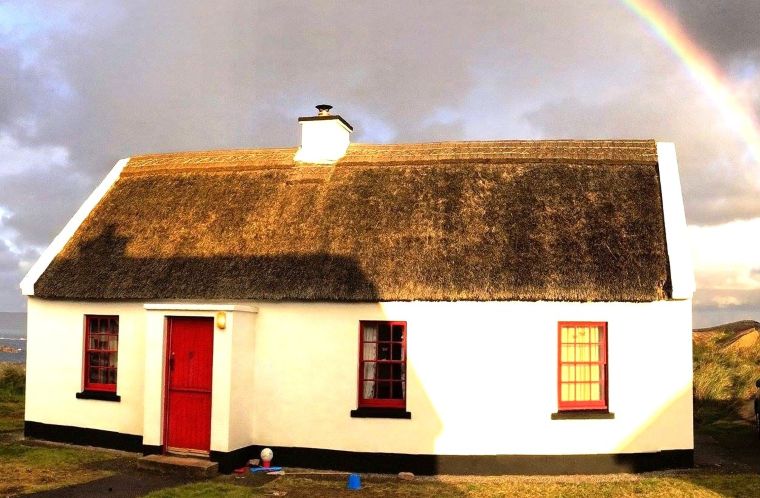
For Conor and Mary Ward, Donegal Thatched Cottages was never just a commercial venture. Instead, the business grew out of a lifetime of pride in heritage and a long-standing love for Ireland’s western coastline. The couple’s story began in a Dublin dancehall in 1967, where they met, and is now centred on a thriving, family-run cottage development on Cruit Island off Donegal’s southwestern coast.
Conor remembers the night he met his wife with clarity and fondness. “In those days, the men lined up on one side of the floor and the women on the other side. It was all a bit chaotic, but it actually worked because dancehalls were the venue where almost all couples met.”
The pair married in 1969 and honeymooned in Donegal, staying at the Portnablagh Hotel. They then took to the road with a small tent, a Mini Cooper, and a secret. “My dear mother, God rest her soul, was so embarrassed at the idea of us spending the second week of our honeymoon in a tent that she swore us to secrecy! It was such a different Ireland then, and so much more innocent.”
Soon afterward, they emigrated to Canada. “We enjoyed our two years in Canada, but we really missed our own people, our own heritage and our culture.”
Upon their return, the duo discovered that city life was no longer for them. After laying a map of Ireland across the table, they chose the west. “We wanted to live where the heart of old Ireland was still beating strong.”
Their move to Sligo in 1972 set the stage for all that followed. By 1976, while camping, a chance encounter proved fateful. “I gave a lift to a German couple who were hitching a ride. They told me that they were coming from Owey Island, and that they had met a family from Northern Ireland who owned a holiday cottage and invited them to stay with them for a few days. I was intrigued and asked them what they had been doing on Owey.
“I still remember their exact answer forty-nine years later: ‘We were drinking poitin and fishing for lobster.’”
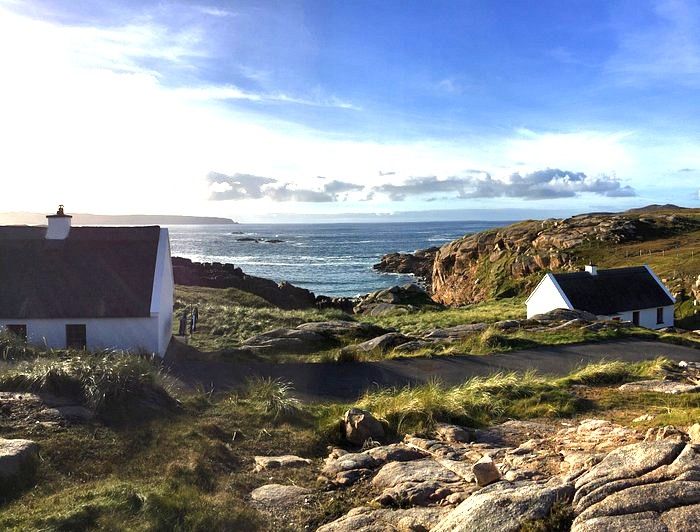
The pair soon visited Owey and became enamored with its remote location and windswept landscape. “We determined right then and there that we were going to come back next year and buy a wee holiday cottage on Owey. And that is exactly what we did.”
For years, the family spent summers there, living entirely off-grid. “It was an amazing experience. Sometimes we were the only ones on the island for weeks at a time,” Ward recalls. “During that time, we came to know Cruit Island well, and the seeds of Donegal Thatched Cottages were born.”
As the idea began to take root, Conor learned that Bord Fáilte (Irish Tourist Board) was offering grants for the development of self-catering accommodation. He saw a possibility if his wife, Mary, approved. Her condition was simple: “I’m fully behind you, provided the roofs are thatched.”
Choosing the perfect site on Cruit Island was its own task. “Finally, we found one last place, totally hidden behind rocks. The instant I saw the site, I knew that this was it!”
A Bord Fáilte representative saw the same potential. “She was bowled over by it, and in due course we were informed that our application was successful.” Later, the planning officer also approved.
Construction began in November 1981 and was completed by 1982. “We absolutely needed that first summer season to stay afloat, and it was a miracle of grace that we managed 100 per cent occupancy for July and August.” As autumn arrived, they focused on building off-season interest through national TV exposure, travel-guide features, and campaigns abroad. “Mary and I travelled to Germany and promoted the cottages there.” They also met with other owner-managers to produce a full-colour brochure “at a time when most promotional literature was still in black and white.”
Today, the cottages remain a cherished family legacy. Though four were sold during the COVID-19 pandemic, the rest are staying in the family. “We are holding on to the remaining six cottages, as we have six children.”
Today, for Conor and Mary, every visiting family member, friend and traveller discovering Cruit Island harks back to their own early instinct to follow the “heart of old Ireland.” And in the end, their venture offers exactly that: a place where heritage, landscape, and Irish warmth continue to live, breathe, and welcome others home.









Leave a Comment