

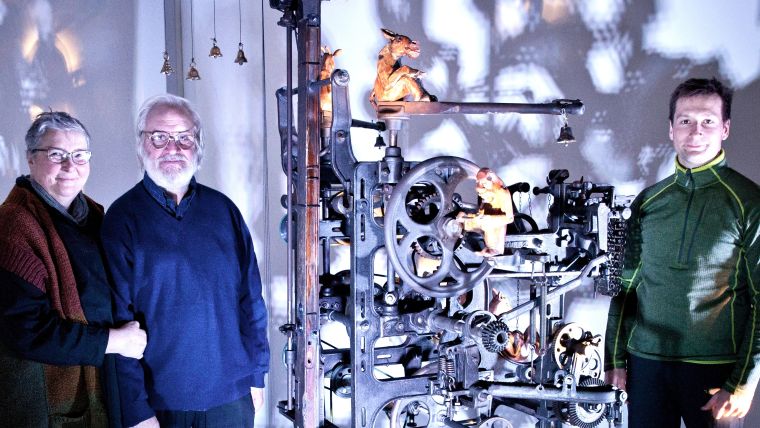
The first time I heard the word ‘Sharmanka’ it conjured up a sense of something mysterious, magical, perhaps eastern, with images of Aladdin or Ali Baba and the Forty Thieves racing through my mind. In truth, it is the Russian word for ‘barrel organ,’ and although my preconceptions may have held some element of truth, nothing prepared me for my recent visit to Sharmanka Kinetic Theatre in Glasgow’s Trongate.
Stepping inside, it felt part theatre, part gallery. The large, rectangular room featured sizeable, free-standing objects along the walls. In the centre, two smaller, three-sided rooms placed back-to-back with three rows of elevated seats in front of each gave the audience a sense of looking into a domestic living space filled with mechanical contraptions. There was an underlying truth to this that I would come to understand later. The objects were made of wood, industrial and household scrap, and a mesmerizing myriad of strange, carved figurines, animal skulls, wires, chains, wheels, and even sections cut out of Venetian blinds. There were angels and demons, bellringing monks, a mole, rats, clocks, and even an image of Vladimir Lenin. In themselves, they were fascinating pieces of static, objet d’art – but the real magic was that they didn’t stay still. Each work came alive to the accompaniment of eerie, theatrical lighting, dancing shadows, and powerful music covering everything from classical, pop, blues, and jazz, through to the accordions of Paris’ ‘golden age.’ It is against this background of whirring wheels, beating wings, spinning acrobats, animated figures, and accompanying locomotive toots and whistles that the meaning of Sharmanka takes form. It is wild, it is crazy, and it is riveting (no pun intended). I observed moments of humour interspersed with the dark and macabre, political satire, and spiritual contemplation in equal measure alongside references to the cycle of life and what it means to be human.
Sergey Jakovsky runs Sharmanka Kinetic Theatre and is its artistic director. He is the step-son of the creator of these works, and as we sat in the kitchen next to the artist’s workshop, he explained – with a distinctive Scottish-Russian accent – that Glasgow’s Sharmanka is a long way from its origins in modern day St. Petersburg, Russia.
“My step-dad, Eduard Bersudsky, grew up in what was then Leningrad, USSR. Amongst spells in other jobs, he was a night guard and a boiler man. In his spare time, he carved small, wooden figures. At first it was little more than a serious pastime, but soon it grew into something more.” Around the mid 1970s, Bersudsky began to breathe life into his creations.
By fitting small motors and sophisticated electro-mechanical devices, he experimented with kinetic sculptures that he called kinemats.
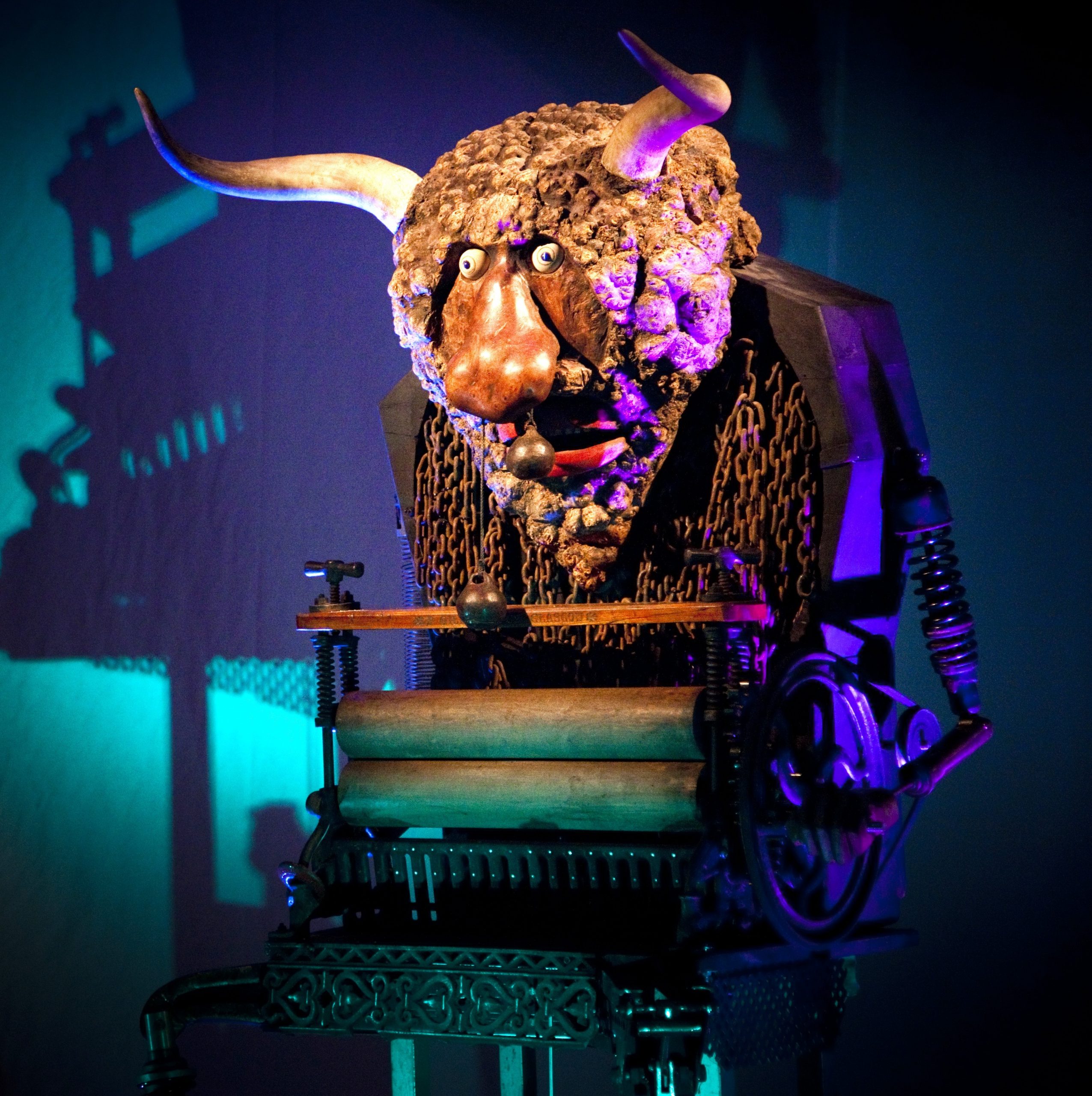
He was a non-conformist artist with no formal training and experimenting with an art form that was ideologically and aesthetically unthinkable at a time when communist Russia was promoting ‘social realism.’ Consequently, his ever-growing collection of kinemats filling his single room in a communal flat were hidden from the authorities, and seen only by close friends and family. When Bersudsky met theatre critic, director, and wife-to-be Tatyana Jakovskaya in 1988, Gorbachev’s perestroika (restructuring) had been in place for three years, and rules were easing. Jakovskaya saw the potential to turn Bersudsky’s kinematic art into a theatrical experience, and together they launched Sharmanka Kinetic Theatre in St. Petersburg the following year. It was the beginning of encompassing lighting, exploring the use of dramatic shadows, and capturing the power of synchronized music.
Sharmanka began to attract international attention, but just as it was gaining recognition, Russia entered a period of economic decline and funding for the arts was withdrawn. It became apparent that the family would be unable to continue their theatrical journey in their homeland. With the help of renowned furniture maker Tim Stead and his wife Maggy – a linguist and graphic designer respectfully who lived in Scotland and had visited their theatre in Russia – the family moved to Scotland, where their work was already garnering attention. Glasgow Museums purchased several pieces and Sharmanka held its first Scottish exhibition at the McLellan Galleries, Glasgow in 1994, with a permanent base opening in 1996 in Glasgow’s Trongate area.
The family quickly adapted to their new home, learning about its people and culture. By the time Sharmanka relocated to Trongate 103 Arts Centre in 2009, they had already exhibited extensively across the UK, Ireland, mainland Europe, USA, and Israel. While the early works are understandably influenced by his upbringing in Russia, Bersudsky’s later works find themselves rooted in Scotland’s culture and heritage. With the area around Saint Petersburg being flat, the family embraced the opportunity to climb Scotland’s hills and look across a landscape dominated by mountains, rivers, and lochs. They developed a fascination for Celtic mythologies, folklore, and storytelling, resulting in some uniquely Scottish works such as Jock’s Jokes – created with scrap from the collection of a chimney sweep called Jock Redburn. Last Eagle Of The Highlands is a suspended, winged artwork featuring two antlered skulls dedicated to Mike McGrady who fastidiously studied Golden Eagles, while Willie The Barrel Organ is dedicated to a pony named Willie who watched Bersudsky work and unknowingly provided psychological support as the artist transitioned to life in a new country. What makes Bersudsky’s work stand out from other automaton sculptures is that not only is it complex and visually stunning, but it embodies deeper meanings that the viewer is enticed to discover; one can observe and be fascinated but looking beyond the obvious leaves one enlightened. Jakovsky observes, “my step-dad doesn’t feel that he creates these works. In a sense, they exist unseen in the mystical qualities of people, time, and place. He considers himself to be the vehicle by which they come into being.
“Scotland, with its rich Celtic history connected to the land and its flora and fauna, has been an artistically enriching experience.”
He pauses, takes a sip of coffee, and adds, “we came here by chance; we stayed by choice. In Glasgow, we felt in the right place as it’s full of crazy people like us.”
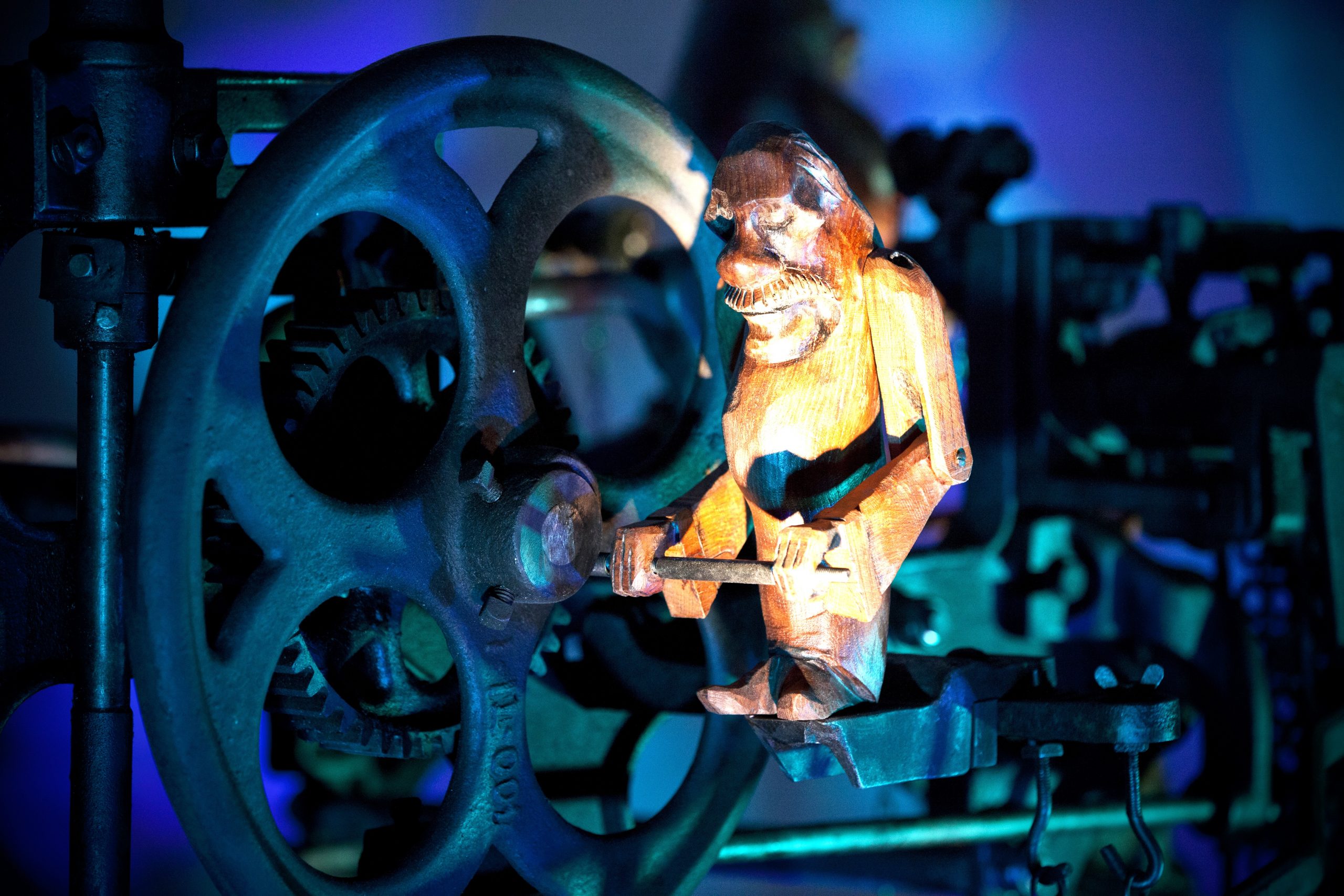
One of my favourite pieces in the exhibition wascalled Am Beairt (“The Loom”). Commissioned by Ann Lanntair – an arts centre in Stornoway on the Outer Hebrides – it honours the deep tradition of Harris Tweed weaving on these islands. Artist and step-son collaborated on this – their only, and last, large-scale work. By disassembling an original Hattersley pedal loom and reconfiguring it as a metaphor for regeneration, the viewer is invited to consider what this industry once meant to the islanders, and the effect the loss of such skilled crafts has upon those who live there. Operating the huge loom is a small, solitary figure who works tirelessly to support all the other animals that populate the artwork. It is a powerful piece with a sense of timelessness, portraying not only a localized craft industry, but man’s relationship with the land and nature at large.
Bersudsky’s creations have featured in international touring exhibitions, while individual pieces have been acquired by, commissioned for, or exhibited in museums and galleries across the UK and abroad, as far away as Korea and China.
My afternoon at Sharmanka Kinetic Theatre felt like I had been inside someone else’s inescapable dream. When you get to a certain age in life – and I’ve been here for a while now – you feel that there is little left that will amaze and surprise you; Sharmanka did that in bucketloads! The nearest I can get to describing it is to take the imagined creations of Heath Robinson, the surrealism of Salvador Dali, the religious, macabre morality of Hieronymus Bosch, and the gothic, horror fantasy of Tim Burton, place them in a blender with a smattering of scrap, and press the switch. The result was an afternoon of sheer wonderment. ~ Story by Tom Langlands
www.sharmanka.com
Photographs by Robin Mitchell













Leave a Comment