

Some depictions of modern Celtic spirituality almost feel like fast food. We can log in to any social media platform and be given a one-minute crash course on manifesting money with a candle and a handful of herbs, courtesy of a bright-eyed influencer ‘channeling’ a goddess. Similarly, a casual web search for Celtic lore may find us scrolling through Instagram reels explaining how a mythical figure can ‘help’ us attract a mate, win back an ex, or, if necessary, put a hex on them instead. In today’s noisy new-age culture, exploring myths and legends is often portrayed as a quick convenience or like some otherworldly trip to the amusement park.
As author Trevor Miller observes in his reflection on Celtic spirituality, “publishers were falling over themselves to get books published while the interest was there,” comparing much of today’s quick-fix spiritual fascination to “‘Being a Celt for a day-type experience, like some sort of spiritual Disneyland.”
Although this type of enthusiastic revivalism does reflect genuine interest, it can miss the mark. With global uncertainty at a fever pitch, many people are looking for clarity and get hooked by the empty promise of instant relief. While the search for the sacred might be sincere, it is clear how easily mythical characters can become content, packaged for quick consumption.
Now, admittedly, the true purpose of legend and lore is not easily discerned. To be fair, the dilution of myth into a mood or a little magic is not necessarily blasphemy. In uncertain times, people seek meaning wherever they can find it, especially when consumerism and spectacle no longer satisfy. Still, something essential is lost when myth, particularly Celtic myth, becomes a caricature of its original condition.
Carl Jung says that “the primitive mentality does not invent myths, it experiences them.” In other words, myth is not a customized fantasy we can create for wish-fulfillment. Rather, if anything, it is something that essentially helps to create us as a culture.
What emerges from the murky historical record of Celtic myth, in particular, suggests that myths are less effective at helping anyone escape reality and more about finding ways to live with it.
It helps to define how myth is perceived and organized within a given culture in the first place. Unlike the Greek and Roman pantheons, the lore and legend that spanned the Celtic nations and parts of continental Europe included a range of interconnected languages and tribes. It was never a fixed or unified system. In addition, what we now recognize as “Celtic mythology” was not firmly established or recorded until the medieval period, which surely altered the original stories told in ancient times.
 Initially, these stories were handed down through an oral tradition in a pre-Christian era. They were shaped by region, landscape, and communal experience, creating a shared identity and collective memory. Most were only written down much later by Christian monks and scholars who then likely filtered them through their own worldview. In addition, these myths underwent continuous revisions over centuries.
“Celtic myths were composed over hundreds of years during constant socio-politico-cultural change,” notes Gaelic Researcher Séamus Draoigall. The adaptations of the Christian scholars in the centuries following the original oral versions of myth were revised once again by the Celtic Revivalists of the 19th century. A group of Anglo-Irish intellectuals like Lady Gregory, WB Yeats, and Maude Gonne, “set off to recover, rewrite and, most importantly, re-interpret the mythology into the late 1800s,” notes Drapigall. He is not alone in this viewpoint.
Like many other scholars and researchers, he asserts that “the earliest stories are from the 700s AD, well after the establishment of a network of monasteries and schools,” and it didn’t stop there. “With the coming of Vikings (late 800’s AD), Normans (1100’s AD), and up to the dissolution of monasteries in the Tudor times (mid 1500’s AD), Celtic mythology kept growing and changing.”
It is obvious then that the original meanings of the myths may have been distorted or even lost entirely. Draoigall asks an important question: “Should we really build our idea of what Celtic spirituality was like in the Iron Age from a mediaeval Christian author writing about a tribe of ‘god-peoples’ 1,100 years later?” here may not be a clear answer, but one thing we know for sure: What survived is not a perfect record of ancient belief, but a layered legacy subject to memory, interpretation, and historical circumstance.
The reworking of myth over time shows up in the figure of Brigid. As Welsh scholar Gwilyn Morus-Baird explains in his discussion of Imbolc, many of the associations accepted by modern practitioners (and influencers alike) are not supported by historical evidence. “We have different names and depictions – Bríg, Brigantia, Brigid – for what we might assume to be the same mythic figure,” he notes. “Yet when we look at the actual sources for Imbolc in the Irish tradition, it is not clear whether the pre-Christian Brigid had anything to do with Imbolc at all. Most people assume Brigid to be a Christianized version of an earlier goddess, but we have no evidence of this.”
Morus-Baird is careful to mention that this is not a dismissal of modern practice. “I do not want to invalidate anyone’s beliefs,” he adds. “They are valid and coherent. We simply do not know whether the early mythological Brigid was associated with Imbolc before her absorption into Christianity.” Despite anyone’s winsome wishes, the gap between historical uncertainty and casual contemporary content is very real.
So, while myths may not be historical facts, they are not merely stories either. As Donn Harper Jr. writes in The Power of Myth, they provide “our sense of individual identity as well as our communal sense of identity,” forming the framework through which meaning, language, and cultural imagery are understood. In that sense, myth subtly affects how a society collectively and subconsciously orients itself – not with a strict set of instructions, but as a kind of cultural shadow, shaping what we value without us even noticing.
Seen this way, Celtic myth was less about belief and more about belonging – its history is layered and complex and not easily traced.
Séamus Draoigall further cautions that, “too many mainstream authors and popular social media personalities keep running on programs of this face-value approach to their own heritage.” Rather than approaching with a critical eye, he says, many are “happy to be told what their own spiritual inheritance is.” Delving into myth, he warns, demands “interest, depth of mind, consistency, discernment and love” if it is to be understood at all.
Seemingly then, Celtic myth is derived from a vast and uneven repertoire, shaped by time, place, and transmission, rather than any precise pantheon. Even so, certain gods, goddesses, and legends have endured not because they provide a blueprint for modern life, but offer, perhaps, an old-world method for handling the hard choices within it.
Speaking of choices, one of the most popular figures in Irish mythology is Cú Chulainn, whose story forms the foundation of the Táin Bó Cúailnge. He is remembered for his bravery and brilliance as a warrior, yet the Táin does not depict him as an invincible hero. It is a cautionary tale about the dangers of pride and power, which, like any intoxicant, can do more harm than good.
Cú Chulainn’s strength is tangled up with his limits. He is bound by geasa, sacred vows that both empower and restrict him. Although the vows are meant to shape his character, they also become the cause of his downfall. Facing an impossible choice, his story ends in tragedy. Ultimately, his courage demanded sacrifice, isolation, and relentless endurance.
Like the rest of us, Cu Chulainn is not immune to consequence. His story reflects a recurring pattern in epics, in which the hero answers a call that cannot be refused, even at the cost of death. Author Joseph Campbell writes, “You must give up the life you planned, in order to have the life that is waiting for you.” This rings true not only for Cu Chulainn but also for any modern-day spiritual seeker.
If Cú Chulainn exemplifies the cost of bravery when pushed to its limits, the Tuatha Dé Danann reveals how such power is not easily maintained. Traditionally associated with beings of the natural world, the Tuatha Dé Danann are the mysterious peoples of the goddess Danu. According to the Lebor Gabála Érenn (The Book of Invasions), they came to Ireland with the Four Treasures, bringing great skill in magic, warfare, and craftsmanship. They fought the Fir Bolg and won, and became rulers of the land, and were later overpowered by the Milesians and driven underground. As one account from the Bagtown Clans explains, after their defeat, the Tuatha “became the Sídhe (fairy folk), living in mounds and caves, which became the origins of Irish fairy lore.” With that retreat came a message that power does not always remain within easy reach.
The Tuatha stories may reveal that magic and presence are not always available to humans. The article “The Garden of Eden and the Tuatha Dé Danann” connects these Otherworld beings to the influence of the Christian monks who recorded the story. It suggests that “the Tuatha Dé Danann somehow represent an unfallen aspect of creation, existing unperceived all around us.” Further, the original “sin” in the Garden is compared to the “consequence of no longer seeing (true) reality the way the Tuatha Dé Danann do.” It might be a stretch, but the point is that the withdrawal of the Tuatha after their defeat is a lesson on how even great power has limits and must be earned over time – there are no shortcuts.
If the Tuatha Dé Danann reveal a world where power is withdrawn and hidden, the tales of the Morrígan teach us to move into and explore that darkness.
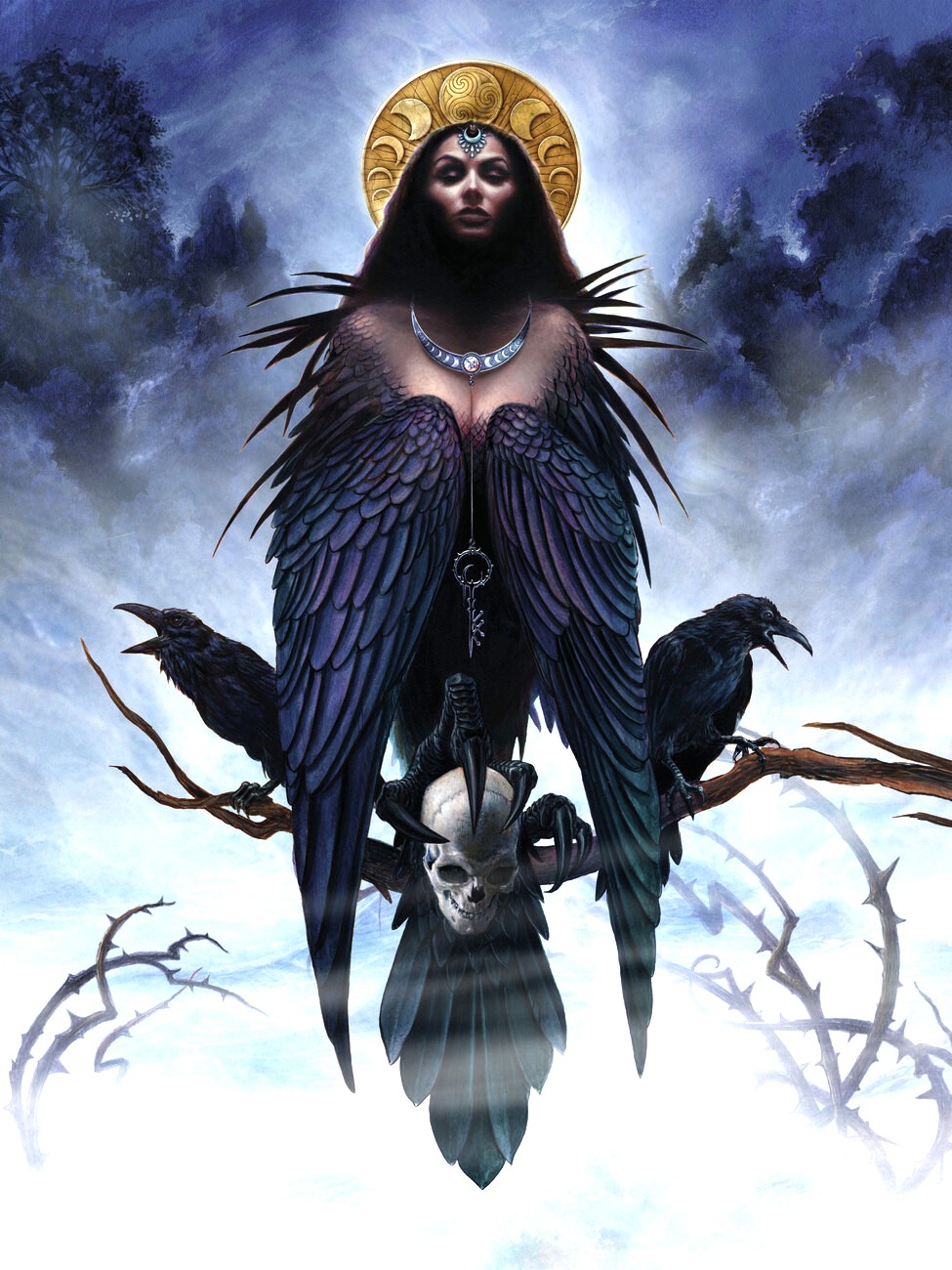 One of the most frequently misunderstood figures in Celtic mythology, the Morrigan in contemporary culture is often called upon to handle righteous anger, or even revenge. A quick search on social media connects this dark goddess with everything from war and personal power to shape-shifting and social justice. As a modern-day bardic baddie, she is called upon to invoke protection, dominance, or retribution. In “The Morrigan Is A Goddess for Protest,” the author writes, “To many modern devotees, she’s a goddess who represents the right to rule yourself and your body as a kingdom inviolate. There’s an argument that this isn’t historical, that the Irish didn’t conceptualise sovereignty that way, but honestly, it doesn’t matter.”
Or does it matter? In older surviving sources, the Morrígan is not a goddess who grants favors or butts in on behalf of individual desire. She appears at moments of change, conflict, fate, and the messy aftermath of human actions. She does not rescue heroes from their choices, nor soften the cost of excess or pride. The Morrígan does not offer easy solutions but stands at the point where responsibility and consequence converge.
Perhaps, for a modern practitioner anyway, the point of any myth may be to simply awaken our own intuition and come to our own conclusions.
Yet, if Celtic myth teaches us anything at all, it is that power is never casual and transformation is never instantaneous.
The Tuatha retreats. The Morrígan reveals. Cú Chulainn pays the price. These stories do not exist as fast-food wish fulfillment, to punish social enemies in the evening, or soothe our anxiety in the afternoon. They point to a slower, more solid kind of spiritual work. The kind that builds character, not content.
Despite all, many Celtic myths have survived and remain popular through the many changes of the ages. Even with all the fragmentation over centuries, the patterns and themes within Celtic lore remain visible, though the messages take some work to absorb. And that may be the point. Celtic myth may not dole out precise instructions, but it can provide a measure of timeless insight when left to simmer in our consciousness for a while rather than being served up for instant consumption. It then becomes less about getting what we want or changing our circumstances, and more about recognizing what we have and changing ourselves.













Leave a Comment